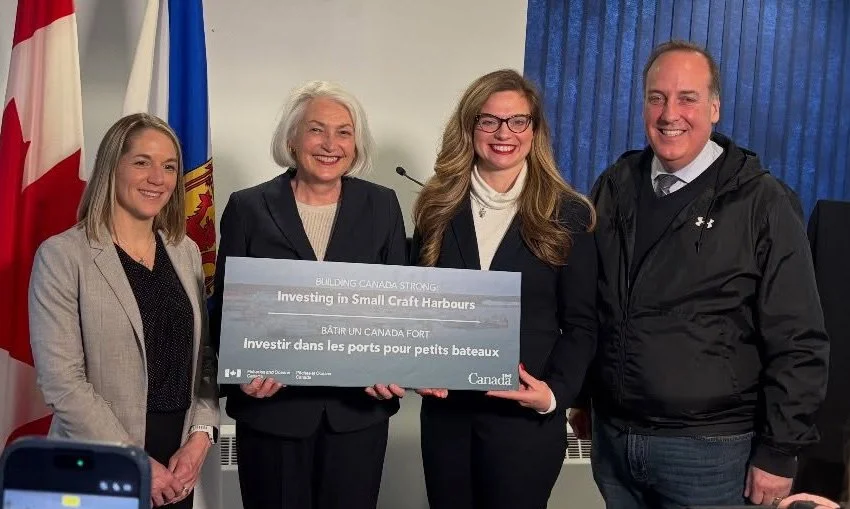
Liberal MP Jessica Fancy, third from left, pictured with Liberal MP Shannon Miedema, Joanne Thompson, Minister of Fisheries, Oceans and the Canadian Coast Guard and Liberal MP Chris d'Entremont, announcing an investment to repair and modernize small craft harbours. / FACEBOOK PHOTO
South Shore-St. Margarets MP Jessica Fancy says calling herself the “Government of Canada Slumlord” during a national Liberal caucus meeting helped make the case for increased investment in small craft harbours.
“I went to the mic and I said, you know, I'm here today not as Jessica Fancy, the Member of Parliament for South Shore-St. Margaret's, but I'm here today as the Government of Canada Slumlord,” she told The Rural Roundup recently.
Fancy said she brought accounting models, cost estimates and information about infrastructure assessments to support her argument. She raised the issue several times and credits that advocacy, along with support from Fisheries Minister Joanne Thompson, with helping to secure a $1 billion investment over five years for small craft harbour repair, maintenance and modernization, announced in the spring economic update.
“People are coming up to me all the time now, and they're saying, ‘Jessica, can you small craft harbour this?’” she said.
Fancy, who recently became chair of the Liberal Rural Caucus after serving as vice-chair, said the experience demonstrates how rural MPs can influence federal decisions.
The caucus has also gained a more prominent role within the Liberal government.
Fancy said 40 of the approximately 60 Liberal MPs representing rural ridings are members of the rural caucus. The group has grown over the past year and a half and now has representation on the national caucus executive.
That allows the rural caucus chair to deliver a weekly report to the prime minister during national caucus meetings, similar to reports provided by regional representatives.
“I'm hoping that people and stakeholders will start to notice in a lot of the policy development that there will be some type of rural lens,” Fancy said.
She said one priority is developing a consistent definition of rural Canada across federal departments, which currently use different approaches to determining what qualifies as rural.
Fancy is a former teacher who was first elected to Parliament in 2025. Fancy’s interest in rural advocacy predates her election to Parliament. She grew up on a family mushroom farm, wrote a thesis focused on prioritizing rural Nova Scotia and previously chaired the Rural Communities Foundation of Nova Scotia.
She said that experience made taking on the leadership of the federal rural caucus a natural progression.
Beyond small craft harbours, Fancy pointed to federal procurement as another area where rural advocacy is producing results.
She cited a contract awarded to Hawboldt Industries, a company in Chester, N.S., to supply winches and cranes for the shipbuilding procurement announced in August.
Fancy said she became involved after learning the work could go to a Norwegian supplier.
“They're not going to do it over my dead body,” she recalled saying.
She then met with Secretary of State for Defence Procurement Stephen Fuhr to explain to him how small Canadian manufacturers are capable of ‘building Canada,’ and those contracts lead to downstream economic benefits that work through the full supply chain. The contract was the company's largest, she said, and has also created opportunities for smaller businesses supplying components like control arms and dashboards.
“That's how you fill supply chains. I have that in my riding. I’m very proud of that,” she said.
Fancy said the example highlights the importance of ensuring rural manufacturers have access to major federal procurement opportunities.

“Rural has always been rolling up our sleeves, not afraid to get dirty, and we want these opportunities.”
LIBERAL MP AND RURAL CAUCUS CHAIR JESSICA FANCY
She said the federal government needs to consider how its procurement processes and contract requirements can better accommodate smaller companies that might otherwise struggle to compete for large projects.
Fancy also pointed to a third-generation fisherman in her riding who developed an electronic logbook application as another example of rural innovation.
“That's what rural is. We're very hardworking. The innovation that comes out of rural Canada in particular — it's been very rewarding to see so far.”
Fancy said the rural caucus intends to continue working with stakeholders and across party lines to address issues affecting rural communities.
“I'm probably one of the MPs who’s been well known for working across the aisles with all people because good policy is good policy,” she said. “Having rural actually now being asked to come to the table and help write some of these policies and legislations … I am very excited for that.”
The following Q&A was edited for length and clarity.
RR: What are your priorities as the chair of the Liberal Rural Caucus?
JF: The rural caucus has been looking for a local media carve-out over the past couple of years, similar to what Quebec and Ontario have done. So that's one thing that we have engaged in. We haven't quite gotten the actual carve-out that we wanted, but you would have noticed that our local media print materials, we're sending them now to not just your top five [newspapers] nationally. We had a lot of very positive feedback from our media providers, specifically in print. Now we want to try with radio and expand an actual policy carve-out.
Secondly, they're not in any prioritized order, but definitely rural connectivity. Cellular service is an equity piece. This is an emergency preparedness piece. We are definitely going hard and working with some of our telecoms on a sovereign broadband system. And you would have heard that at the Investment Summit, during the prime minister's speech on creating an east to west to north broadband fibre system. So we're waiting on what that actually means.
Thirdly, looking at labour shortages. You know, we want to build Canada strong, but where are we building Canada strong? It’s rural Canada that's going to be building this for us, right? We're a resource-based economy. All the mining they’re talking about, or big energy that they talk about, housing and infrastructure, is being built in rural Canada or it’s being started in rural Canada and shipped to urban areas for installation.
Rural has always been rolling up our sleeves, not afraid to get dirty, and we want these opportunities. But to have these opportunities and try to scale them, we are facing some severe labour shortages.
RR: What was growing up on a mushroom farm like?
JF: It's hard work. You're picking mushrooms every 12 hours. So as a kid, your day would start at three or four in the morning, and you'd help mom and dad pick mushrooms until seven, and then do the farm chores because we had animals. And then you're off on the bus at eight. I had an after school job until 10, and then, oh look, it's almost another 12 hours.
I used to tell my students the same thing. You've got to commit to the grind, right? And it's that work ethic that helps you get things done.
We had an organic farm, so my parents refused to use pesticides, and my mom and dad had to actually get rid of the farm because we lost three crops in a row. Instead of spraying and losing our organic designation, they just chose to get other jobs. So I went through that in rural Canada, the booms and the busts.
RR: Rural Canada is in the spotlight now, as you mentioned, because of major projects and food security. Given all the geopolitical and trade uncertainty, do you think it's getting enough credit for being an economic driver for the country?
JF: I would say that it's nice to know that we're getting blinked at. I will never ever stop advocating for rural, and we'll never say, ‘Oh, it's enough.’ … It's definitely getting more credit, but I don't think it will ever get enough credit until we're at par, until I don't have to go to the mic and talk about a policy carve-out or a percentage carve-out for rural or Indigenous or rural and remote areas.
RR: What is the biggest challenge facing rural Canada right now?
JF: I would definitely say the biggest challenge facing rural Canada is ensuring that communities can attract and keep the people they need. … Whether that's in the healthcare sector, housing, skilled workers, whether it's with broadband or economic growth, rural communities need that population base and the services that allow families and businesses to thrive. There's a lot of opportunity in rural.
RR: What are the biggest opportunities?
JF: We have what the world wants. When you look at us in terms of our resources, our natural resources, energy, and a lot of the agriculture we help produce, we have everything the world wants and needs, and a lot of that is housed in rural Canada. We should be celebrating that, and we should be working on policies that safely take care of those resources while also highlighting everything we have to give.
RR: I just want to go back to the challenges. Are there some solutions that can help address the issue of people staying in rural Canada?
JF: Having more people in urban areas come live in rural Canada, point blank, we have lots to give. As you're seeing some of our broadband issues come into play, people can expand those services into more rural communities. The solutions would also give us the opportunity in some of these policy carve-outs to scale in the ways we want and to plan better. That's what we've heard from a lot of our stakeholders. They don't want to spend the capital because they don't know right now, and that could be due to tariffs or to needing the people to scale. There’s also fuel costs right now, … and affordability issues.
RR: The Rural Prosperity Group also advocates for a rural lens on public policy. Do you agree that it's needed?
JF: I think everything I've said today speaks to advocating for a rural lens on our public policy. So I definitely would agree with that.
RR: What is your message to governments when it comes to rural Canada?
JF: We are here. We have what you need. We aren't afraid to roll up our sleeves and work if given the opportunity. Whether that's looking at the way that we change our regulations, cutting some of that red tape, helping bolster our SMEs and better support them with updated policy legislation — how do we take some of these policies that quite frankly, haven't been looked at since 1991 and bring them up today to ensure in the next 30 years we're not having these same types of questions?
RR: Is there anything keeping you up at night?
JF: The geopolitical and tariff situation. I'm a planner, as a lot of farmers are. You know, we always have to plan for the crop or the year ahead. I want to make transformational change, and in order to do that, there's stability that's needed. And right now, in a couple of different sectors there is no stability. That’s what I think of — where will we be in a year from now?