
Previewing a budget geared to generating private sector investment in the economy, and increase trade
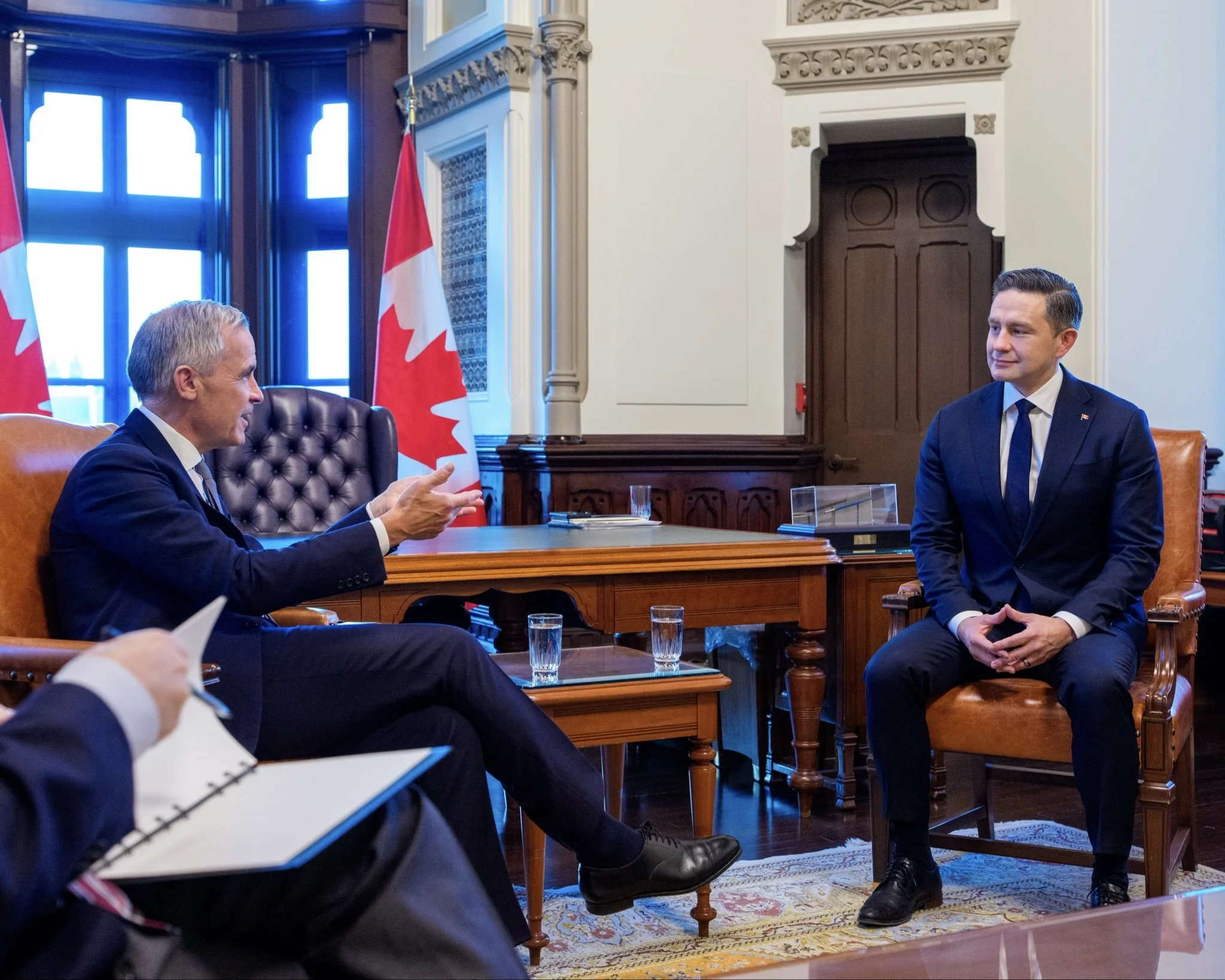
Prime Minister Mark Carney spoke with Conservative Leader Pierre Poilievre ahead of finalizing Budget 2025. / TWITTER PHOTO
Prime Minister Mark Carney announced a major federal investment in new nuclear energy technology in Ontario as he previewed his government’s economic strategy ahead of the Nov. 4 budget.
To help build the first of four small modular reactors (SMRs) next to Darlington Nuclear Station near Toronto, Ottawa will spend $2 billion through the Canada Growth Fund, and Ontario will contribute $1 billion.
Carney joined Premier Doug Ford in Bowmanville on Thursday to make the announcement, noting SMRs represent the kind of technological advances that will provide excellent jobs and economic benefits for Canada in future.
The SMRs will inject $500 million annually into the Canadian supply chain, while construction, operation and maintenance of the units will increase Canada’s GDP by more than $38 billion over the next 65 years, Carney said.
“We are an energy superpower, and we are only getting stronger. This project will make us the first in the G7 to have an entirely new kind of nuclear reactor,” Carney remarked. “[It is] a generational investment, an investment that will extend Canada's world leadership in clean energy.”
Carney, who said he is eyeing corporate tax breaks in the upcoming budget, continued this week to give Canadians an advance look at how the Liberal minority government hopes to change the economy in the face of the U.S. tariff attack.
Sector-by-sector
The prime minister prompted new concerns about the prospects of renewing a tariff-free trade relationship with the U.S. under President Trump. Carney said U.S. officials are currently only interested in negotiating possible reductions on Trump’s sectoral tariffs on sectors like steel and aluminum — not on resetting an across-the-board free-trade arrangement.
“We’re having very detailed, specific, constructive negotiations for the steel industry, the aluminum industry,” which include talking about “elements” of the energy industry and “a few other components in there, because the Americans are moving to an approach which is sector by sector, as opposed to global,” he said.
So the need to diversify Canadian trade away from the U.S. and build more goods domestically has become all the more more urgent, Carney said.
“Our goal for Canada is to double our non-U.S. exports over the next decade, generating more than $300-billion more in trade,” he said. “We used to build things in this country. We can build again.”
Asked for details, Carney noted the federal government's support for port development, citing Grays Bay in Nunavut and the Port of Montreal's expansion project.
Unlocking potential
“You'll see more on that,” he said. “Then, what are we exporting more of? It can be critical minerals from the Ring of Fire and building that up. We're working closely in terms of unlocking that enormous potential.”
In his ongoing effort to sell Canadians on the Liberal budget in advance, Carney also said for the first time that the budget will bring in a “climate competitiveness strategy,” which he said would “focus on results over objectives.” No details were provided.
Also included in the Nov. 4 package will be a new immigration plan that would match immigration levels “with our needs and our capacity to welcome them.”
And Carney said the “core” of the budget will feature measures to generate investment in the economy. “Our government has the fiscal capacity to act decisively and we must draw on these strengths now,” he said, going on to say the government wants to “catalyze unprecedented investments” over the next five years.
He warned that Canadians may face some sacrifices as the budget prioritizes pro-growth investments while aiming to reduce the federal government’s operational spending. But, answering reporters’ questions, the prime minister stopped himself from revealing what government programs or services might be cut or capped at current spending levels. However, he said social programs will be protected.
Federal support for apprenticeships, skills training and a new talent strategy “for the next generation of scientists and innovators to build their careers in Canada” will also be in the budget, Carney said.
He also said the budget will prioritize a Buy Canadian policy, particularly for Canadian lumber, steel, aluminum, manufactured goods, and technology for domestically produced projects.
FINA submissions
The House of Commons Finance Committee received 948 submissions to its pre-budget consultation, including one from the Rural Prosperity Group.
The following are a few highlights from submissions that recommend support for rural Canada:
Federation of Canadian Municipalities
Dedicated rural infrastructure funding: The government should provide at least $500 million annually for 10 years in dedicated rural infrastructure funding.
Rural infrastructure is the first step in getting products to market, but rural municipalities have large infrastructure burdens and small tax bases. Dedicated funding for new rural infrastructure and maintaining existing rural infrastructure like roads and bridges will deliver nation-building projects, enable trade diversification and boost productivity.
Dairy Farmers of Canada
Recognize the agriculture and agri-food sector as a core driver of Canada’s economy by applying a rural-agricultural and competitiveness lens to government decision-making.
Rural Canada and its agricultural community are important parts of the fabric of our country and are vital to a thriving Canadian economy. The agri-food sector collectively contributes almost $150 billion annually to Canada’s GDP and employs 2.3 million people. We are the largest manufacturing sector and a key driver of domestic economic growth. We are also an important partner in sustainability and ensuring continued food security for Canadians. Despite this, the sector is often an afterthought in the policy development process – which can lead to policies that have unintended consequences, some of which can impact our growth and global competitive interests.
The federal government should reflect the agriculture and agri-food sector’s status as a national priority and core driver of Canada’s economy by ensuring that a rural-agricultural and competitiveness lens is applied to the policy development process. To support this objective, the Cabinet Directive on Regulation should be amended to mandate that such a lens is applied to regulations established under key government regulators like the Pest Management Agency (PMRA) and the CFIA. This would enable them to reflect the economic and competitiveness interests of producers, while safeguarding the health and safety of Canadians and the environment.
Canadian Nurses Association
Workforce planning and mobility: Strengthen integrated and open workforce data systems, utilizing Nursys and Canada’s unique nurse identifiers, and apply forecasting tools to align workforce supply with population health needs. Harmonize nursing regulation and licensure across jurisdictions to create a more consistent and coordinated approach and enhance the mobility of the nursing workforce, particularly to improve access to care in rural, northern, and Indigenous communities. Further investments will be required for the nursing regulators to fully implement Nursys in Canada, to inform workforce planning regarding supply and distribution.
Society of Rural Physicians of Canada
That the government reinvest $25 million in the National Advanced Skills and Training Program for Rural Practice to enhance health care capacity in rural communities.
The need for a robust, skilled, accessible workforce has never been more urgent. Ensuring physicians practicing in rural communities have the skills that extend beyond comprehensive primary health care e.g., emergency care, anesthesia, obstetrics, surgery, palliative care, and mental health is essential to ensure patients are able to access high quality care in rural communities.
Rural Municipalities of Alberta
Prioritize Investments in Rural Economic Corridors. Efficient transportation corridors connecting rural producers and resource sectors to national and international markets are essential for economic growth. Federal infrastructure programs should:
Target improvements in key rural corridors that facilitate the movement of goods such as agricultural products and energy resources.
Enhance connectivity and logistics capacity to maintain Canada’s competitive position globally.
Support rural municipalities in managing corridor infrastructure to maximize economic benefits. Strategic investments in these corridors will unlock rural economic potential and strengthen supply chains.