Feds, Alberta announce cooperative deal to open way for a possible new pipeline
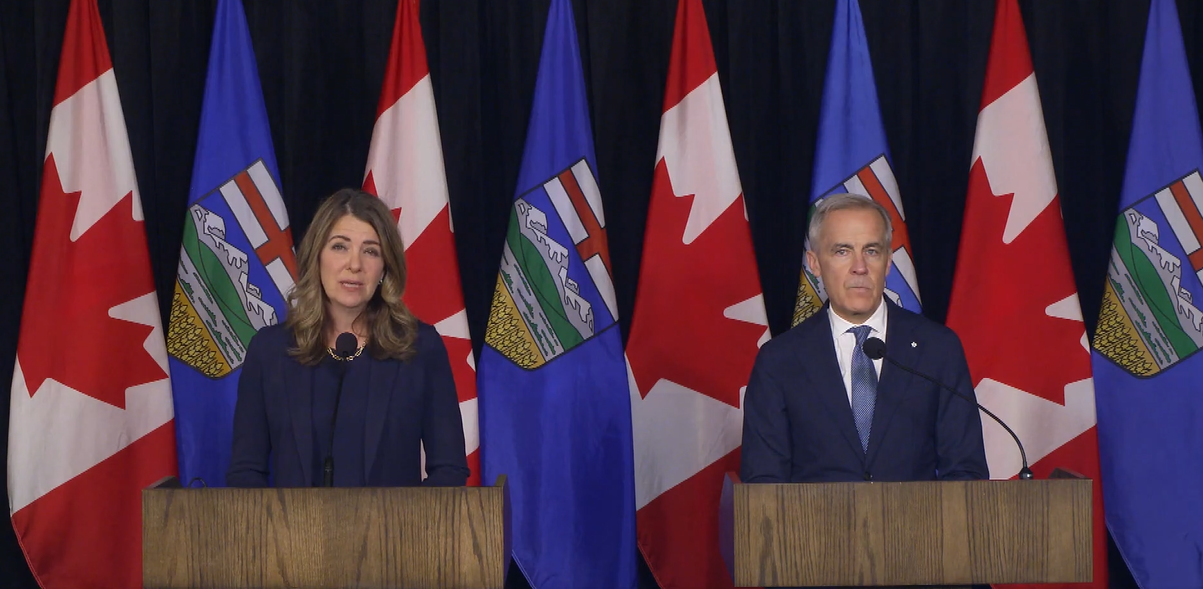
Alberta Premier Danielle Smith, pictured with Prime Minister Mark Carney, announced that the two governments signed an ‘implementation’ agreement for a new pipeline. / SCREENSHOT
Prime Minister Mark Carney and Alberta Premier Danielle Smith announced a new implementation agreement aimed at diversifying Canada’s exports, reducing emissions and strengthening the economy through major energy and infrastructure projects.
A central part of the deal is Alberta’s commitment to submit a comprehensive proposal for a bitumen pipeline to Asian markets to the federal Major Projects Office by July 1, 2026. The federal government, in turn, will seek designation of the project as one of national interest under the Building Canada Act by Oct. 1, 2026. Both governments said the process would depend on discussions with British Columbia and compliance with the duty to consult Indigenous Peoples.
Alberta hopes to begin pipeline construction to a West Coast port by Sept. 1, 2027, with oil flowing by 2033-34. The province will officially become the project’s proponent on July 1, 2026, though details on a required private-sector partner have not yet been released.
The agreement also ties into ongoing discussions over the proposed Pathways Alliance carbon capture and storage project, which Ottawa has identified as a condition for approving a new pipeline. No final decision has been made.
However, both governments reaffirmed support for Pathways, saying the project could reduce emissions by 16 million tonnes annually — equivalent to removing 90 per cent of vehicles from Alberta roads — while generating $16.5 billion in GDP, $12.2 billion in labour income and up to 43,000 jobs each year.
Talks between Alberta and British Columbia on a future pipeline are also focused on benefits for B.C. that could support the province’s own infrastructure priorities.
The agreement includes a new carbon-pricing framework, with Canada and Alberta agreeing to an effective carbon price of $130 per tonne by 2040. Interim benchmarks include $115 per tonne by 2030 and $130 by 2035.
The two governments also agreed to stricter annual emissions benchmarks under Alberta’s Technology Innovation and Emissions Reduction (TIER) system. Alberta will introduce a minimum floor price for TIER credits beginning in 2030 to stabilize carbon markets and provide investment certainty.
Canada and Alberta will jointly issue 75 million tonnes of Carbon Contracts for Difference to support emissions-reduction projects, with costs split equally.
On electricity, both governments agreed to work toward doubling Alberta’s power grid by 2050 through expanded nuclear, wind, solar, geothermal and other lower-carbon generation while maintaining grid stability.
A new joint Electricity Working Group will identify projects and investments needed to achieve net-zero emissions in Alberta by 2050, including support for renewables, storage, transmission, interties, nuclear and geothermal energy. The governments also pledged to encourage renewable investment and expand electricity supply for AI and data centre development.
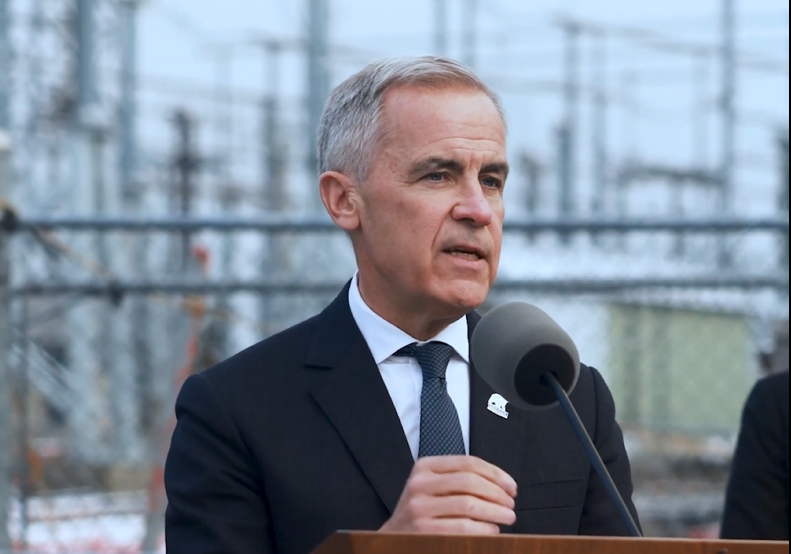
At a press conference, Carney rejected suggestions that support for a West Coast pipeline was intended to calm rising separatist sentiment in Alberta. “I view that very much the best place for Alberta is in Canada,” he said, “and certainly, a Canada that works, which is what we’re pursuing.”
Separatist efforts to hold an independence referendum this fall have faced setbacks after a court ruling quashed the Smith government’s approval of the vote, partly over inadequate consultation with Indigenous groups. Smith is appealing the decision.