Indigenous ownership key to building major projects in the North: Northwest Territories Premier Simpson

Moderator JP Gladu, Principal of Mokwateh; Sean Boyd, Chair of the Board, Agnico Eagle; Anne-Raphaëlle Audouin, Chief Executive Officer of Nukik Corporation; Erin O’Toole, former Conservative Party leader; and Northwest Territories Premier R.J. Simpson spoke about Indigenous participation in major projects on a panel at the Public Policy Forum Growth Summit. / MEANS & WAYS PHOTO
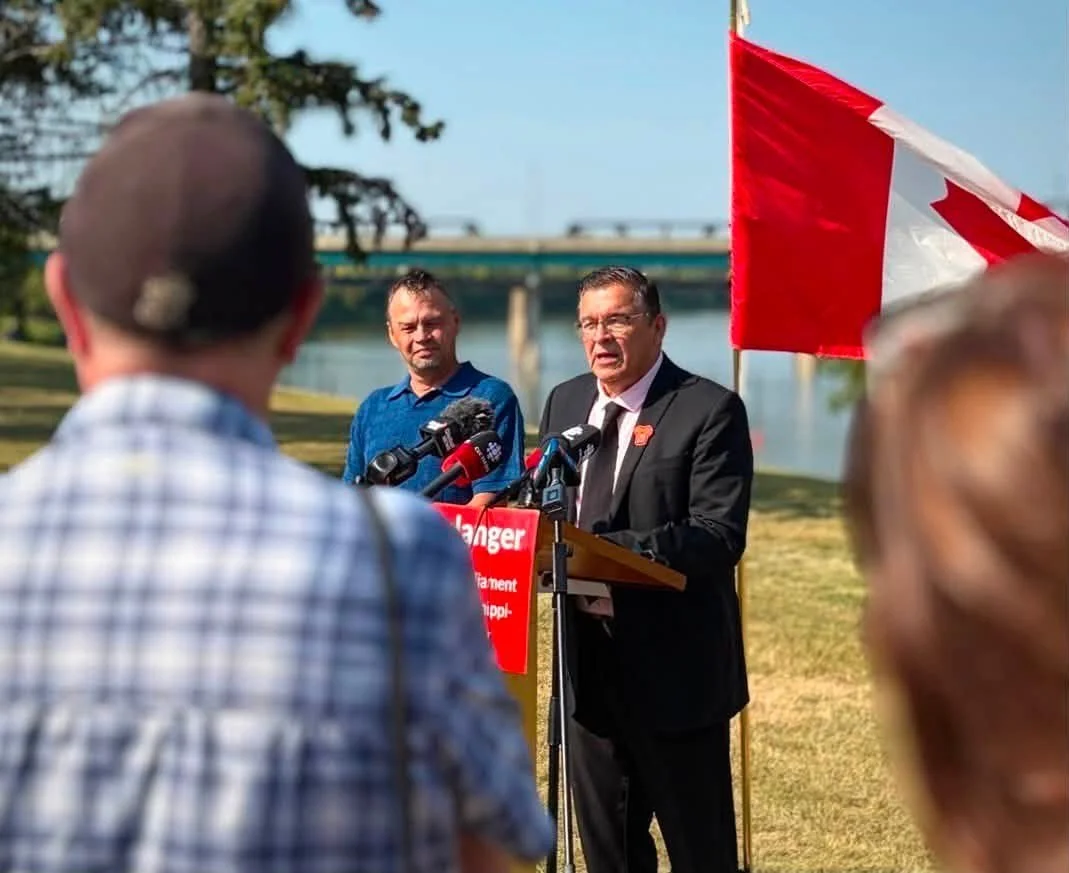
TORONTO – Without Indigenous ownership and participation in major northern projects, they won’t get built, says Northwest Territories Premier R.J. Simpson.
Bringing Indigenous people and communities in is why these projects are moving forward, Simpson said May 7 at the Public Policy Forum Growth Summit in Toronto. “Otherwise, people are willing to lay down in the road and make sure these projects don't happen.”
Simpson pointed to the Mackenzie Valley Highway as an example of how Indigenous-led advocacy can work. “The Indigenous governments from up and down that route have all come together, and we've jointly advocated to the federal government for this project, and we've been very clear to the federal government that this needs to be done on our terms as the owners, which means there needs to be robust Indigenous involvement.”
Simpson, speaking on a panel about Arctic investment, contrasted that vision against recent history, citing the Giant Mine remediation project as a missed opportunity for economic reconciliation. The mine operated for decades, releasing 200,000 tons of arsenic trioxide dust into the environment and affecting communities that relied on the land. When the remediation contract went to American-based multinational Parsons rather than to a local Indigenous development corporation, it illustrated precisely the problem the North is trying to move past.
It’s ‘not complex’ to have the necessary conversations
“It's not complex on how to bring people in,” Simpson said. “It just takes time to understand the situation, have those conversations and create the current processes that are responsive to that.”
The panel also featured Sean Boyd, Chair of the Board at Agnico Eagle, Anne-Raphaëlle Audouin, Nukik Corporation CEO and former Conservative Party of Canada Leader Erin O'Toole. The panel was moderated by JP Gladu, Principal of Mokwateh, an Indigenous-owned consulting firm.
Audouin, whose corporation is 100% Inuit-owned, described a territory that covers 20% of Canada's landmass but remains almost entirely cut off from national infrastructure.
“There is no road, there's no bridge, there's no transmission line connecting the rest of the country,” Audouin said. The consequence is total dependence on imported energy and foreign-controlled communications. “One hundred per cent of all of our energy needs are met by diesel — schools, businesses, hospitals, industry, everybody relies on diesel.” Most years, 100% of all petroleum products come from outside Canada, mostly the U.S., she said.
The digital situation is equally precarious. “Our telecommunication is low-orbiting satellites that mostly relies on Starlink, owned by you know who in you know where,” she said, referring to Elon Musk in the U.S. “Simply put, Nunavut has no energy security and has no digital sovereignty.”
Audouin argued that Inuit ownership of major projects emerged not from a desire for profit, but from necessity. “The Inuit didn't start on that ownership cycle for bigger projects because they were hoping for financial gains,” she said. “They really looked at it as ‘We are not thriving here, and we are not going to be able to thrive as a society if we continue to rely on others.’”
She said the Inuit took the lead on projects to fill a “gap in the governance” caused by the federal government’s failure to lead. “You cannot have true self-determination until you have that economic autonomy.”