Canada must build economic resiliency and expand agri-food processing: Blois
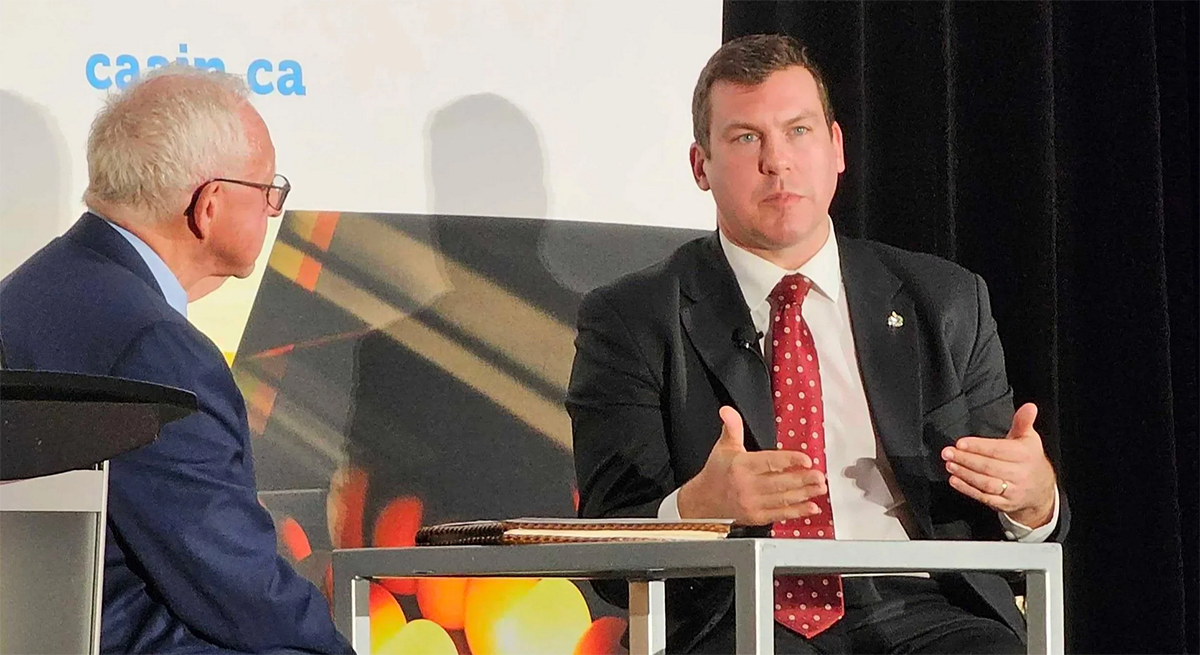
Agriculture is ‘a fundamental pillar of the Canadian economy,’ says Liberal MP Kody Blois, Parliamentary Secretary to the Prime Minister, pictured with Kim McConnell, former CEO of AdFarm. / RURAL PROSPERITY GROUP PHOTO
Canada must move quickly to strengthen its economic resiliency by building major national projects, expanding agri-food processing, and attracting global investment, Parliamentary Secretary Kody Blois said Tuesday, outlining what he described as Prime Minister Mark Carney’s vision for a more secure and competitive country.
Speaking at a Canadian Agri-food Automation and Intelligence Network event Feb. 9 in Ottawa, Blois said the government is focused on working more closely with provinces, municipalities and Indigenous communities to advance projects that support long-term growth.
“Let’s focus on economic resiliency. Let’s build major national projects. Let’s work with Indigenous communities. Let’s invest and bring in investment from around the world,” Blois said about the government’s vision for Canada in conversation with Kim McConnell, former CEO of AdFarm.
He acknowledged frustration in Western Canada, particularly around energy and natural resource development, where previous governments were seen as less invested.
“I understand some of the frustration,” he said. “But I don’t think anyone in this country can say that this Prime Minister does not take seriously every corner of the country.”
Blois said the government is pushing to modernize Canada’s economic strategy as global instability reshapes trade, investment and supply chains.
“We cannot take our good fortune and our natural endowments for granted,” he said. “That is no longer the world we can rely on.”
Expanding agri-food processing
A key priority, Blois said, is accelerating domestic agri-food processing, an area where Canada lags behind competitors.
“Our investment in agri-food processing is behind the United States. It’s behind Europe,” he said. “So how do we draw that in?”
Blois framed agriculture as “a fundamental pillar of the Canadian economy” that underpins both jobs and national resilience.
The agriculture sector employs one in nine Canadians and contributes more than $150 billion annually to GDP. Blois highlighted the sector’s complexity, with farmers and agribusinesses navigating multiple federal portfolios, from labour to biofuel policy to business risk management programs, and stressed the importance of innovation funding to drive growth.
Blois pointed to a $200-million agri-food domestic processing fund included in the Liberal platform as an initial step, calling it “a beachhead” for larger investments.
He also highlighted opportunities to attract foreign capital, including from sovereign wealth funds such as the United Arab Emirates, suggesting that even a small allocation could inject billions into Canadian innovation and processing capacity.
“If you took five per cent of that fund, that would be $3.5 billion towards agri-food innovation and investment,” he said.
He noted that government’s role is not to pick projects, but to create the policy conditions needed to catalyze private investment.
“This is not about designating a project. It’s about how do you catalyze private-sector investment,” Blois said.
Infrastructure, ports and rail critical to food system
Blois also emphasized the importance of transportation and logistics infrastructure, particularly ports and rail, in supporting food affordability and export competitiveness.
“Some of this comes down to rail investment. Some of this comes down to stability between employers and unions, recognizing these are critical functions,” he said.
He pointed to recent discussions with port authorities across the country aimed at boosting competitiveness, modernizing operations, and increasing digitalization.
“These investments are absolutely crucial,” he said, noting that disruptions at major ports such as Vancouver have nationwide impacts.
Rising reliance on imported food moving through U.S. supply chains is also contributing to food inflation, Blois said, particularly as tariffs and transportation costs increase.
“When those products are tariffed on their way in, that’s part of why we’re seeing food inflation,” he said.
Canada positioned as stable investment destination
Despite geopolitical issues, Blois said Canada is increasingly attractive to international investors.
“In a world of uncertainty, Canada is a stable jurisdiction,” he said, adding that conversations with global business leaders reflect growing confidence in Canada’s long-term prospects.
“You talk to Canadian CEOs and you hear concern,” he said. “But when you talk to global CEOs, it’s a vastly different conversation.”
As Canada navigates shifting trade relationships and geopolitical pressures, Blois said agriculture and food security remain central to the government’s economic strategy.
“Countries that can’t feed and fuel themselves can’t defend themselves,” he said. “Canada has what the world needs.”