New DFC head AcMoody calls for ‘steadfast’ trade support amid CUSMA pressure
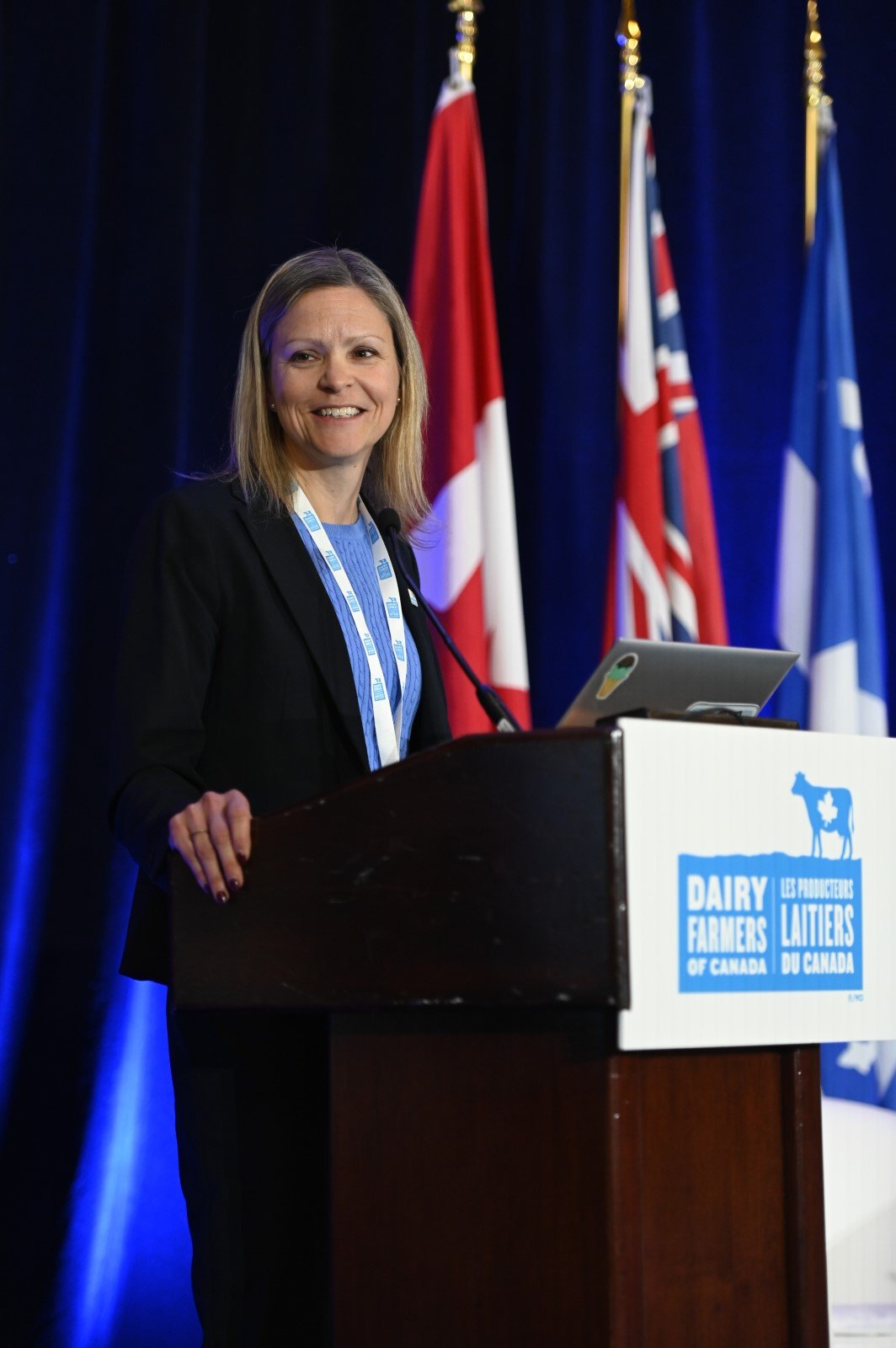
New Dairy Farmers of Canada CEO Annie AcMoody says dairy farming is ‘critical’ to rural Canada and is ‘a strong economic engine for rural Canada.’ / DFC PHOTO
The newly appointed CEO of Dairy Farmers of Canada is calling on the federal government to remain "steadfast" in its support of supply management as the sector navigates an increasingly volatile global trade environment.
"All the parties have voiced their support for supply management, as has the Prime Minister. Keeping that united voice in trade discussions will be important, as we know stability is key when it comes to planning for the future," Annie AcMoody, who took on her new role in February, told The Rural Roundup. "That's something we really need to keep clear in discussions moving forward."
The call comes as Canadian dairy farmers and the government face mounting pressure from the U.S. government to allow more dairy imports as part of the Canada-U.S.-Mexico Agreement review. U.S. President Donald Trump has repeatedly said Canada's supply management system is a trade irritant.
With the CUSMA review on the horizon, AcMoody said consistency and partnership between government and industry will be critical. "There are always challenges, but it would be hard not to mention the current geopolitical instability. I think it adds significant pressure for Canadian dairy farmers because they are seeing it discussed in the media all the time. But I think that could also apply to farmers right across the country."
Prior to becoming CEO, AcMoody worked with DFC for over five years, most recently as Vice‑President, Policy & Trade. She has 20 years of experience in policy and economic analysis within the dairy sector, spanning both Canada and the U.S. Before joining DFC, she served for 10 years as the Director of Economic Analysis for Western United Dairies, an association representing dairy farmers in California.
According to Statistics Canada data, the number of dairy farms dropped from 12,007 in 2014 to 9,256 in 2024 — an average annual decrease of approximately 2.6%.
AcMoody said the trend in consolidation of farms is not a cause for alarm, putting the Canadian figure in international context. "If you compare it to other jurisdictions, it's actually a much lower rate — in the U.S. for that same period it's close to a decline of 6%, and in Australia it’s almost 5%."
Supply management helps smaller farms remain resilient
She credited supply management with helping slow that consolidation. "With the stability offered by the system, smaller farms can remain more resilient, and we know that farms play a key part in our rural communities," she said.
Beyond the farm gate, AcMoody emphasized the sector's broader economic footprint. "The dairy sector contributed $28 billion in 2023 to the GDP," she said, noting the industry supports an estimated 270,000 job equivalents across the full value chain.
She said dairy farming is "critical" to rural Canada. "It is really a strong economic engine for rural Canada.
"When you have strong farms in rural areas, it supports the local equipment dealer, the bank, the vets — there are a lot of folks who thrive when the dairy sector does," she said. "It's not just a traditional industry, it’s also a strong contributor to Canadian prosperity."
Despite the trade challenges, AcMoody said she remains focused on the long term as a top priority in her new role. “There are certainly a lot of priorities, but the long-term stability and growth of the sector is the most important. Navigating the CUSMA review and international trade in general — the current geopolitical environment is top of mind,” she said. “We're looking at our sustainability roadmap to help producers turn environmental expectations into a competitive advantage for Canadian dairy. It's a long-term process, but we're working to develop ways that we can help farmers at the ground level continue to improve.”
The following was edited for clarity.
RR: You've mentioned the geopolitical and trade uncertainty. What do you think is the role of the dairy sector in ensuring economic growth, productivity and stability during this time?
AA: The conversations around food safety and food sovereignty have been top of mind for Canadians. Our sector can be part of the goal to advance our strategic food autonomy. By having our own food produced here, we protect Canadians from global supply chain disruptions. That's a strength and a role that the dairy sector can play. The stability of the system maintains a predictable economic foundation year after year. We contribute more to Canadian GDP and that helps enable long-term investments in planning and rural infrastructure, which supports local jobs in those communities.
RR: There's a lot of talk about AI and how it's disrupting all sectors of the Canadian economy. Can you tell me about how dairy farmers are innovating during this rapid period of change?
AA: I don't know what the buzzword was last year, but it feels like everybody's talking about it these days. I think farmers have always been thinking about technology and how to improve their processes. Overall, as an industry, I'd say there's already been a lot of progress using automation. There are automated milking systems and AI-driven data to monitor animal health and quality in real-time. I'm sure that technology will keep growing at a fast pace as we move into the next year. This mentality that innovation helps us use less resources, while maintaining high quality production. It is also a tool to help improve resiliency in our industry.
RR: What is keeping you up at night?
AA: There are certainly a lot of things that are keeping us on our toes, if you will. I'd say that the unpredictability from south of the border would be a key one. I think uncertainty is now part of our new normal and it will be like that for the next few years. Ensuring that we're prepared for that CUSMA review and that dairy farmers have the stability they need to plan for the future would be the key one right now.
RR: And what are some of the opportunities that you see for the dairy sector in the future? What are you excited about?
AA: The sector in general has tremendous appeal for a lot of consumers. The fact that we're supporting food security and sovereignty I think is very positive; and our sustainability story builds deeper trust with consumers. There's room for Canada to lead globally as the gold standard for high-quality, traceable dairy production. We have an excellent system, so leveraging all these things are great opportunities for dairy in the future.
RR: What's your favourite dairy product?
AA: That's like a trick question. I've pondered this multiple times, I have to say it’s milk, because it's just the perfect vehicle for my morning espresso.