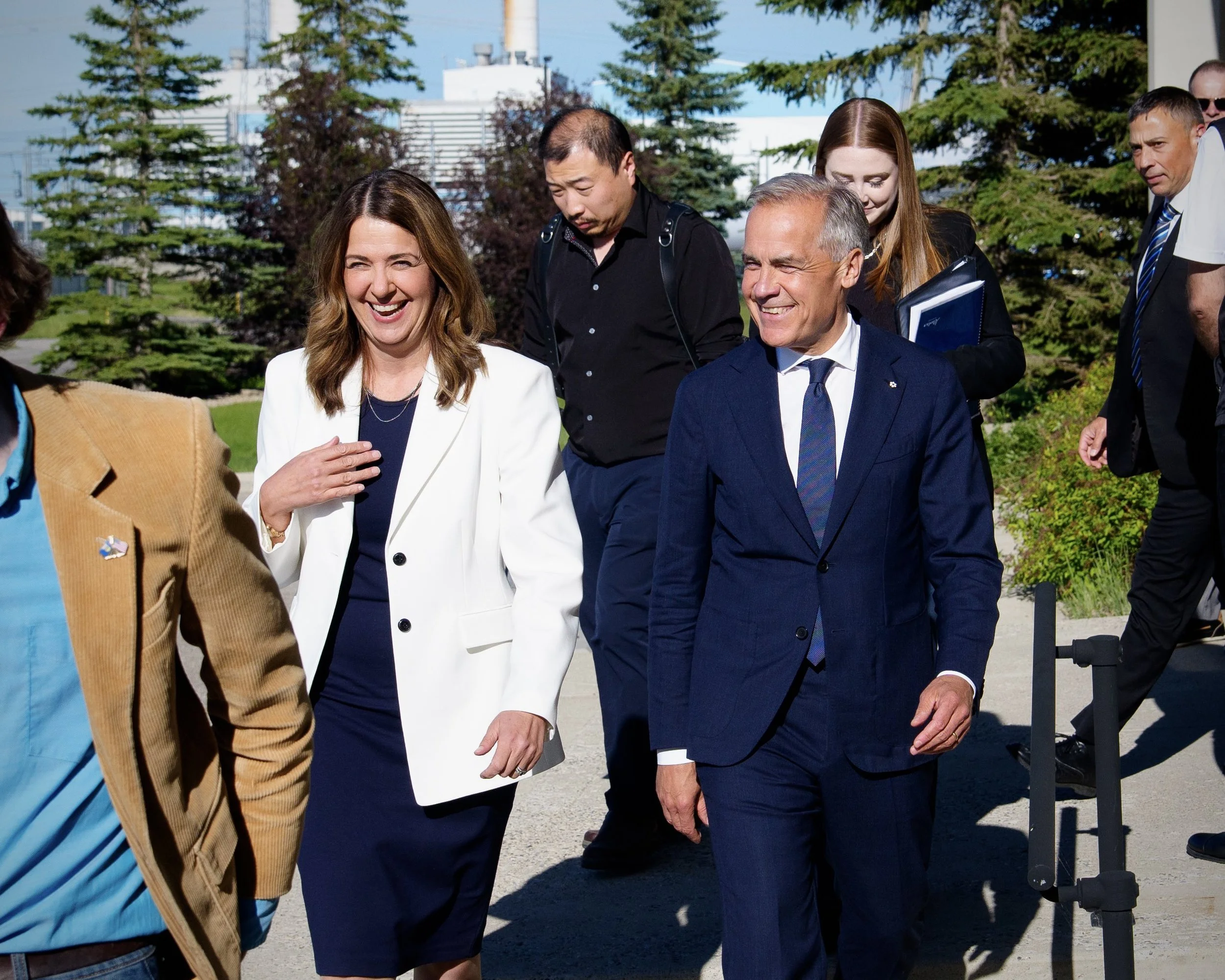
‘A strike is supposed to create economic pressure. That is the point. Workers do not have the power of a multinational corporation. Their power comes from standing together when necessary and, if needed, withholding their own labour. If the government can intervene whenever that pressure becomes too effective, employers have less incentive to bargain fairly,’ NDP MP Gord Johns said in his speech during debate on Bill C-39, the Building Canada Strong Act. / SCREENSHOT
The debate on Bill C-39, the Building Canada Strong Act is about what kind of Canada we want to build and about government priorities. We all agree that Canada needs to build. We need housing. We need clean energy. We need transmission lines. We need public infrastructure. We need good union jobs, and we need to plug economic leakages. We need to diversify our economy and stand up to the economic threats coming from Donald Trump, but we do not want to stand up to Donald Trump by using Donald Trump's policies. A bill like Bill C-5 would not even have come forward from Stephen Harper.
Someone from the Conservative bench said earlier that this is like using a bulldozer and a sledgehammer. Bill C-39 is asking Canadians to accept an enormous transfer of power in the name of speed: more power over workers, more discretion over environmental protections and accelerated timelines for decisions affecting indigenous rights. My colleague from Vancouver East said that beneath this bill “are serious questions about who gets power, who gets certainty and who bears the risk.” We are going to talk about that.
Let us start with the workers. The Canadian Labour Congress commissioned a comparative legal analysis that found Bill C-39 would give the federal government “broader unilateral power to end a legal strike than exists in any other G7 country.” Think about that. Even in the United States, the president cannot simply end a national emergency strike and oppose a permanent binding settlement, as the Liberals are proposing here today. There are legal thresholds, court involvement and limits on intervention that would stop this from happening, yet the government wants to give a Canadian minister, any minister, extraordinary power when a strike is deemed to adversely affect what they deem is in the national interest.
A strike is supposed to create economic pressure. That is the point. Workers do not have the power of a multinational corporation. Their power comes from standing together when necessary and, if needed, withholding their own labour. If the government can intervene whenever that pressure becomes too effective, employers have less incentive to bargain fairly.
We have heard from the CLC, CUPE, Unifor, the United Steelworkers and other labour organizations that have raised serious concerns about these changes. Instead of dismissing those concerns, the government needs to listen to the people who actually represent those workers. It needs to listen to those labour unions. The Liberals keep saying that they are friends of labour. Why are they not listening to them?
The same principle needs to apply to our environment. Environmental assessment is not red tape. Asking what happens to our water, our climate, endangered species and human health before approving a project is basic due diligence. A one-year deadline does not make nature move faster. It is not acceptable to first nations. We cannot undo extinction. We cannot simply restore contaminated water or destroyed habitat after the fact. Environmental organizations have specifically warned that the provisions in Bill C-39 could weaken protections for species at risk, including the critically endangered southern resident killer whale, which my friend from Saanich—Gulf Islands has raised repeatedly.
Indigenous rights cannot simply be squeezed into a government project management schedule. Meaningful consultation requires time, resources and genuine participation before decisions are made. Is it the government that is going to decide when a consultation is complete? Is that how it is going to work moving forward?
We want to build Canada, but let us build Canada where workers have the power at the bargaining table, where indigenous rights are respected, where environmental protection is part of the national interest and where communities do not carry the risk while corporations collect the rewards. Building Canada strong cannot simply mean building Canada faster. It must mean building Canada better, building Canada fairer and building Canada together.
My riding, Courtenay—Alberni, is about a 10-hour trip door to door. My riding is 7,900 square kilometres and represents 34 communities. There are 184 elected officials in my riding, and we are tired. We feel like we are not being heard. It is crazy that I am going to refer to Brian Lilley, but he highlighted that Alberta has 5.1 million people, and it has six senators. We know that they need to be heard. That is clear.
I come from Vancouver Island. We know that we are better off and stronger together. Absolutely, separation is not something we talk about, but on the other side of the Rockies, we know it is harder to be heard, and on Vancouver Island, I can tell this House what it is like. We have not had a Senate appointment since 1970. Brian Lilley highlighted that Alberta has six senators and Atlantic Canada has 30. We have not had a single Senate appointment since 1970. What does that mean? It means we do not have a Senate seat on the fisheries committee at the Senate. Why is that important? I am going to talk a bit about that.
I am talking about building Canada strong. Building Canada strong includes rural communities. Wealth starts in rural communities, but it leaves rural communities. That is what we are used to. When Liberals talk about regions of national interest, why are they not talking to regions and making us part of the national interest?
They promised to fix our fisheries. On the east coast, they fish it or they lose their quota. They do not have foreign ownership of their quota. They do not allow it. We also know who owns their quota. On the west coast, there is no public registry, we allow foreign ownership, and we allow concentration of licences.
A lot of my friends in rural Canada, a lot of people in my riding in coastal British Columbia, go out fishing. They lease from people we call “slipper skippers” who represent the corporate interest that owns the quota. We do not even know who they are. A lot of them could be from Russia or China, could be our adversaries or organized crime. It is unbelievable that this is allowed. In 2018, a study at the fisheries and oceans committee unanimously supported changing it so we could come up with an independent fishery model that reflected the east coast. Nothing has changed. For decades, we have seen this happen.
I am going to quote Dan Edwards, who wrote this week in his Substack, “The value of that asset can rise while the security of the person doing the fishing declines.” That is exactly what is happening. Another thing he said was, “Government policy helped produce those losses. Government has a responsibility to help repair them.” What happened to fast-tracking in dealing with that issue?
When they want to talk about building Canada stronger, what about us on Vancouver Island? Here is what I hear from First Nations when they hear about fast-tracking projects: What about fast-tracking their treaties? What about fast-tracking their agreements? How come the government is not prioritizing that? Is that not nation-building?
We have 65,000 homeless people in this country, including in my riding. It would cost $14 billion to house them. The Liberals can find $45 billion for a pipeline that increases our GDP by 0.6 per cent, but when we look at the impact on people who are homeless, it is much greater than that. The Mental Health Commission did a study and said unaddressed mental health is costing us 5% to 6% of our GDP, $200 billion a year.
The PBO also did a study and said it would cost $4.9 billion to ensure we had parity with mental and physical health, that we could make mental health an insured benefit, based on my bill, under the mental health parity act, but the government chose not to do that. These are economic leakages and economic opportunities, but they impact every home, every community, including in my riding.
We can talk about ferries. Colleagues have heard me talk about this repeatedly. Right now, the east coast gets $182.5 million for operating its ferries. We get $38 million in B.C., despite the fact that we move 22 million passengers and the east coast moves 365,000. Let us go back to Confederation. When we joined Confederation, Vancouver Island had 15,000 people, while P.E.I. had 97,000 people. Today, Vancouver Island has more people than Newfoundland and P.E.I. We get six dollars per capita for ferry operating costs; they get $125. If the government wants to build back stronger, it needs to include the rest of Canada and make sure we have fairness and equity. That is all we are asking for.
When it comes to shipbuilding, ship recycling and ship repair, we can build back better. We can look to Norway, where they take small communities, places like Port Alberni, underused deep-sea ports, and make them shipbuilding, ship repair and ship recycling facilities. We could lead the world since we have the longest coastline in the world.
We are tired of being ignored. If we want to build back stronger, we need to make sure that places like Vancouver Island are included in building back stronger, that the government actually takes the time to listen to us, that we have proper representation from Vancouver Island that reflects that, and that we get acknowledged and not dismissed when we bring forward ideas of unfairness and inequities or when we feel that the government is not acting on the things it has promised to do for too long.
Gord John is the federal NDP Member of Parliament for Courtenay—Alberni, B.C. He delivered this speech in the House of Commons on Oct. 7, 2026.