Investments in Canada’s North should be ‘triple use’
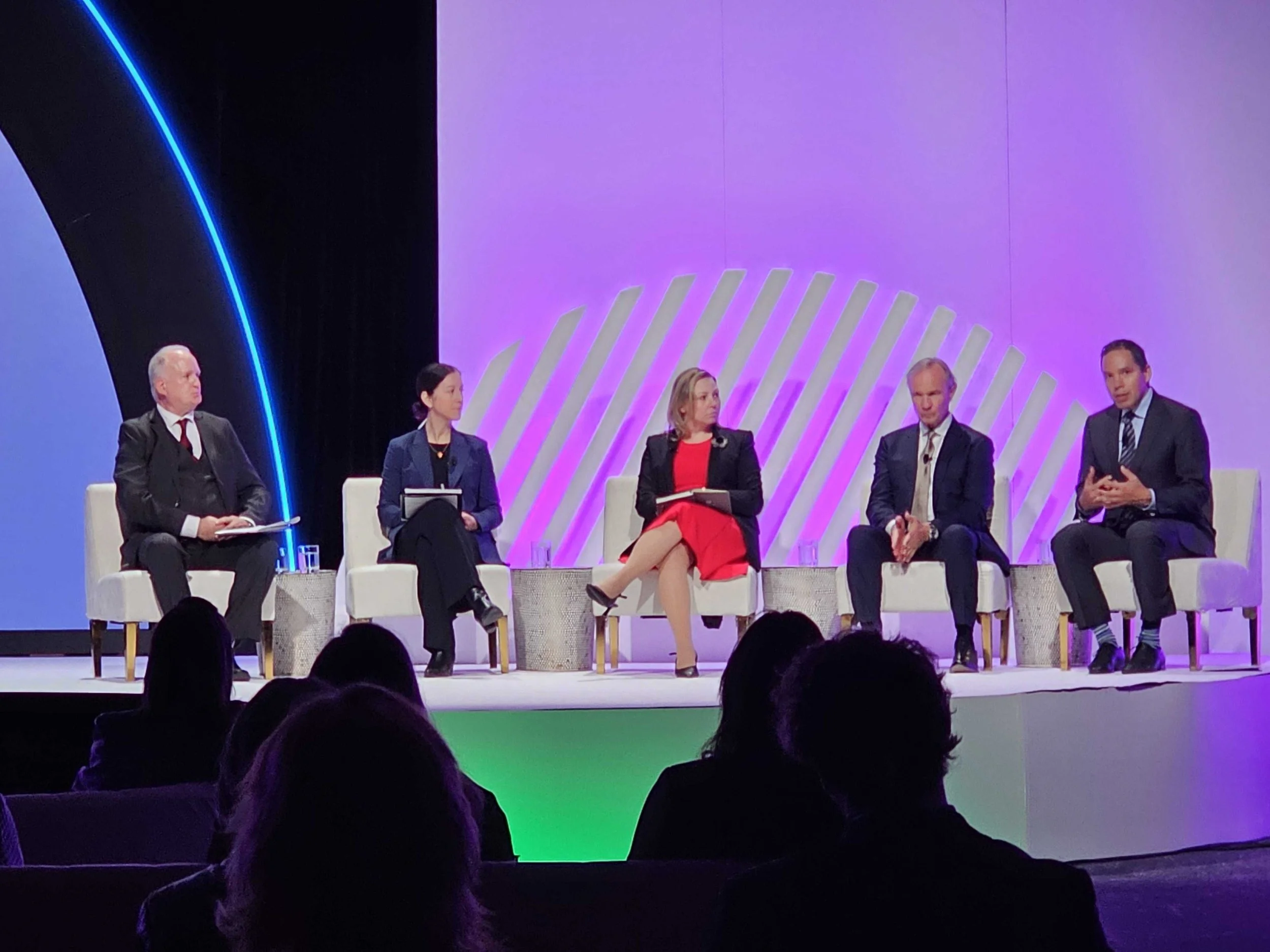
CBC reporter Murray Brewster, National Defence deputy minister Christiane Fox, Heather Exner-Pirot, director of energy, natural resources and environment at the Macdonald-Laurier Institute, Sean Boyd, chair of Agnico Eagle Mines and Natan Obed, president of Inuit Tapiriit Kanatami spoke on a panel about Canada’s North at the Canadian Chamber of Commerce Future of Business Summit this month. / RURAL PROSPERITY GROUP PHOTO
As Canada ramps up investment in the North, considerations for defence, resource extraction and community development should be included in public policy objectives, says an expert in Arctic studies.
"There's some kind of perception amongst communities that any spending in the Arctic is Arctic defence spending and I don't think that's right," said Heather Exner-Pirot, director of energy, natural resources and environment at the Macdonald-Laurier Institute.
"We are not trying to hit a GDP target with defence. We're trying to secure a number of capabilities to defend ourselves and to assist with our alliance," she said at the Canadian Chamber of Commerce's Future of Business Summit April 20-21. "So we need to be careful about what we spend and consider the pros and cons and the trade-offs and the fact that we have scarce resources, and that's always true for the Arctic."
Exner-Pirot, whose doctoral research focused on Arctic studies, argued that the most useful framework for thinking about northern investment is what she called "triple use" — spending that simultaneously serves defence, resource extraction and communities.
"What they all have in common is that they have challenges with remoteness," she said. "They have less access to transportation networks, to energy networks, and to communications networks, and that makes life difficult and expensive and poses a lot of constraints to development."
She asked whether investments in remote energy, transportation and communications could serve all three purposes at once, and whether defence spending could act as "an anchor or an accelerant to figure out some innovation in there."
Exner-Pirot also pointed to the role of the private sector as an underutilized force in northern development. She said the Arctic has gone through significant political evolution over the past two decades — land claim agreements, devolution in the territories — and argued private sector investment should be a priority.
"The next phase is to start attracting more private sector, to be less reliant on federal transfers, to be more attractive to investment," she said. "I think it's very healthy to have entrepreneurs. I think it's very healthy to have royalties and revenues. It's very healthy to have investment."
She said the current moment of heightened attention to the Arctic should be used as a catalyst for other investments.
Exner-Pirot also raised questions about whether that attention will last. She noted that political interest in the Arctic has historically followed commodity prices, surging and fading with the resource cycle. "Can we make it stick? Can we make one or two generational investments that will meaningfully lift up our presence and our capabilities and our development there?" she asked.
Other panelists echoed the need for a broad, coordinated approach. Christiane Fox, Deputy Minister of National Defence, said the scale of current Arctic ambitions demands genuine partnership. "We will not achieve success if we go out alone at DND or the military," she said. "We need to work with Inuit leadership. We need to think about it in the context of Inuit Nunangat."
She cited a range of pressures on the Arctic, including Russian and Chinese infrastructure investment and the effects of climate change. "Climate change will increase accessibility, maybe become a normal approach, a potential avenue of attack," she said.
Natan Obed, president of Inuit Tapiriit Kanatami, said Canada has yet to fully deploy the modern treaties and land claim agreements it has reached with Inuit peoples as tools for Arctic security and development. "Canada does not utilize that asset in the best possible ways that it could," Obed said.
He pointed to Denmark, noting that when the Danish foreign minister appeared at the White House earlier this year, he was accompanied by the foreign minister of the Government of Greenland. Obed described the Government of Greenland as the equivalent of Canada's Inuit regional government.
"Canada needs to do a better job of ensuring that Inuit rights-holding interests are part of our diplomacy, part of the way Canada describes itself to the world," he said. "When it comes to security and defence and sovereignty, we haven't fully realized that potential."
The panel, moderated by CBC defence and security reporter Murray Brewster, also included mining executive Sean Boyd, chair of Agnico Eagle Mines. He said his company's two decades of operating in Nunavut show that northern development is achievable, but argued that physical infrastructure must be paired with investment in communities.
"When you look at the scope and scale with what is being proposed or planned, it's enormous relative to the current size of the economy and the current capacity within the communities, but I think we're starting from a perspective of a willingness to sort of work together and partner and understand the opportunities and move forward," he said. "So I think number one, we have to get the planning right, and I think that's happening, where industry is working closely with communities and working closely with all levels of government to understand what the opportunity set is and how we can work together. The key will be skills. And we can talk about skills training etc, and there's things that have to be addressed in the curriculum in the north. The university will certainly help with that. But really, we have to understand how we can bring those skills to bear there in the north and make sure they're focused on the right priorities. ... We've been part of building a significant business in the north. It's a great example of how that can work."
He said the community is integral to all business investment up north. "Unless we're investing in social infrastructure to elevate the communities, then how do we expect to build those big things? Because you need proper housing. You need the proper facilities. You need proper communications that we talked about. So we can do that at the same time. That's why we're excited about that opportunity, that things can get done."
Obed noted that Inuit peoples occupy a distinct place within Canada's constitutional and political structure. "We don't live on reserve. We're not under the Indian Act. We are citizens of former governments as well," he said. "Our democracies also overlap with municipal, provincial, territorial and federal. The complexity isn't necessarily ours, but I would love for us to harness that for the good of all Canadians."