Rural communities at the centre of Canada’s economic future, Argitis tells First Nations summit
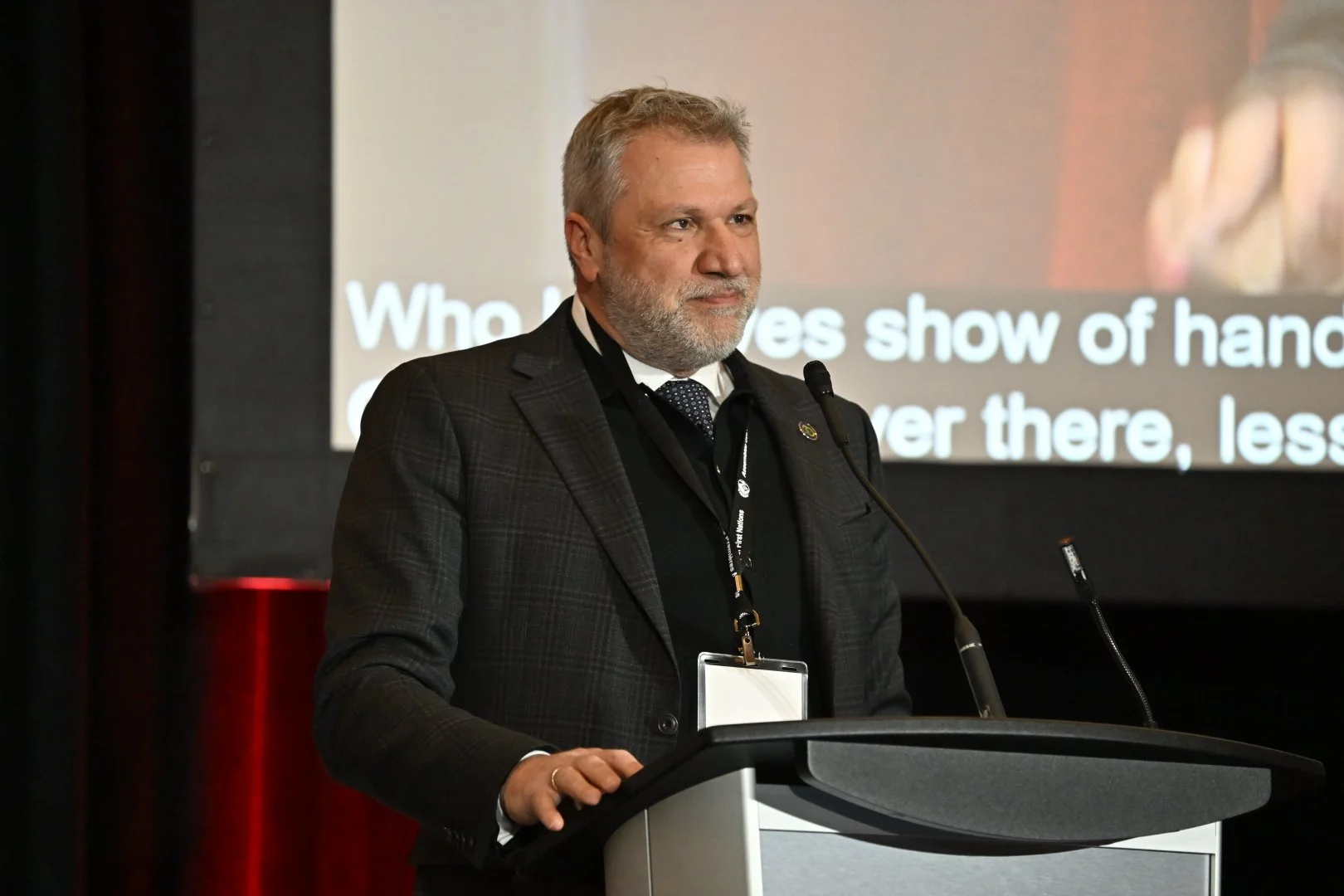
Business Council of Canada vice-president Theo Argitis spoke at the Assembly of First Nations Economic and Infrastructure Summit on March 3. / AFN PHOTO
Rural communities are key to Canada’s economic future and it’s in the interests of Canadians, businesses, governments and First Nations to see these regions prosper, says Business Council of Canada vice-president Theo Argitis.
“When you look at the sectors that will matter most in a more resilient and self-reliant economy — natural resources, agriculture, energy, food production, critical minerals, and renewable energy — many of them are rooted in rural and remote regions of the country,” Argitis said in a keynote address to the Assembly of First Nations Economic and Infrastructure Summit on March 3.
Speaking to Chiefs, business leaders and policymakers, Argitis framed rural and remote regions as critical to the country’s long-term economic resilience, particularly as global instability reshapes national priorities. He said the global economy has entered a period of heightened uncertainty, marked by “pandemics, supply chain disruptions, geopolitical rivalries, energy shocks, and growing political polarization.”
Uncertainty, he said, is the defining issue of our time. As such, governments are responding by prioritizing economic resilience and self-sufficiency. Within that shift, rural Canada is becoming more important. “Rural Canada is at the centre of the economic transformation currently underway,” he said.
Argitis linked this economic shift directly to Indigenous economic partnership.
“Many of the regions that will matter most to Canada’s economic future… are also places where First Nations are rights-holders, land stewards, and increasingly economic partners,” he said.
Indigenous ownership a ‘potential competitive advantage’
“Today we are seeing First Nations become owners, investors, and partners in projects — from energy infrastructure to natural resource development,” Argitis said. “Indigenous equity participation is becoming one of the most important developments in Canada’s economic landscape.”
The Business Council of Canada, he added, sees this as a strategic advantage. “Indigenous ownership is a potential competitive advantage for the country — one that can help unlock investment while ensuring economic benefits are shared with the communities where projects are located.”
He cautioned, however, that policy frameworks have not kept pace with these changes. “Right now, too often, rural regions remain undervalued in national policy discussions,” he said, pointing to gaps in infrastructure, housing, transit and digital connectivity.
“We need better infrastructure. We need stronger transportation networks… We need digital connectivity that allows businesses and workers to operate effectively in remote areas,” he said.
He also urged governments to consider how policies affect resource-dependent regions, saying energy and climate strategies “must always be designed with an awareness of how they affect communities whose economies depend heavily on resource sectors.”
Argitis concluded by underscoring that Canada’s future growth will be driven outside major urban centres. “If we are going to succeed in this new era of change, the future will not be built in Ottawa or Toronto or Montreal,” he said.
“It will be built in communities across the country — in rural regions, in resource regions, and in Indigenous communities that sit at the heart of many of Canada’s economic opportunities.”